
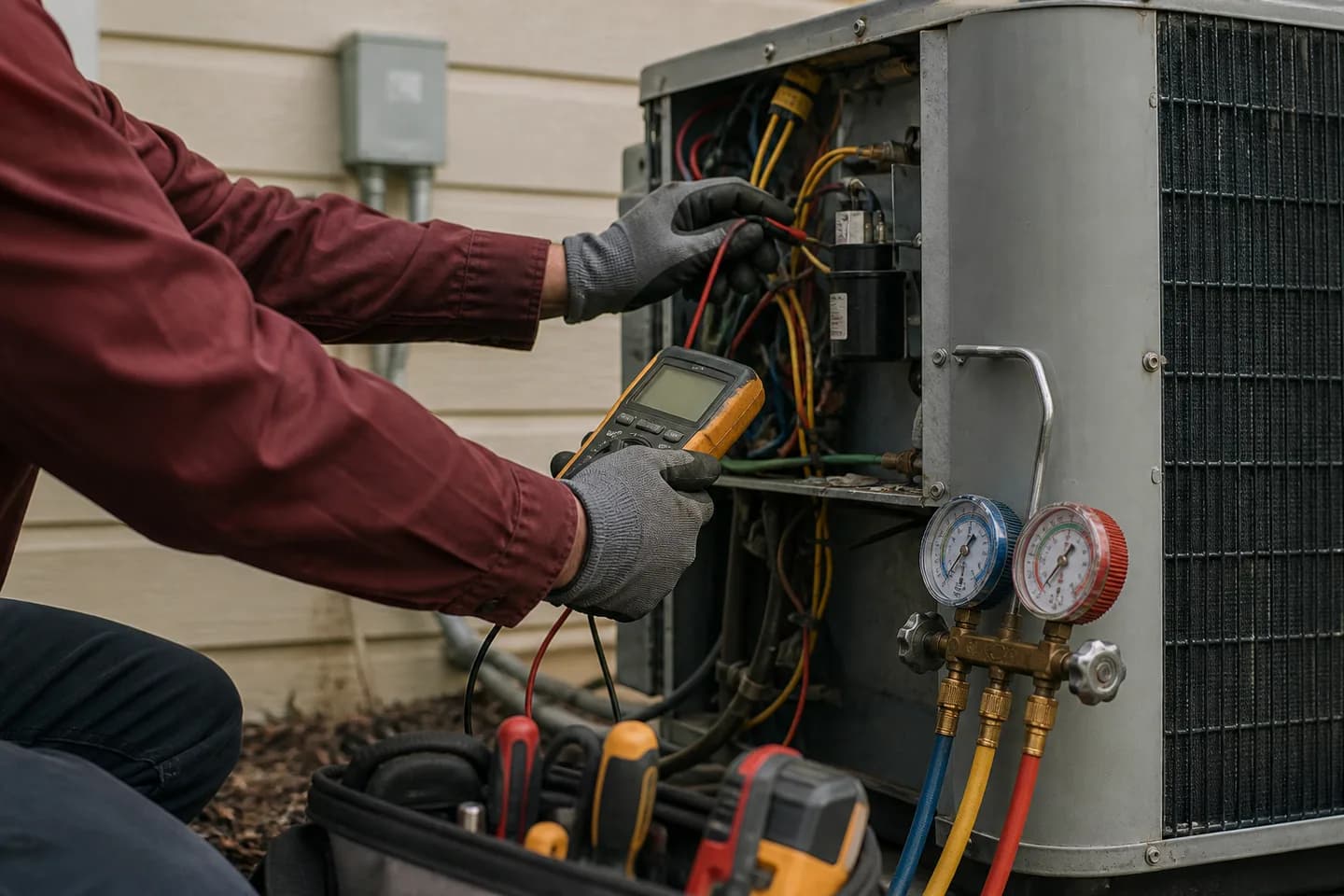
Service for the outdoor cooling unit
The condenser must move heat out of the house.
AC Condenser Repair in Jasper, GA focuses on the outdoor section of a split cooling system. The condenser contains the outdoor coil, fan, compressor, electrical controls, and cabinet that help release indoor heat to the outside air. When it does not start, overheats, makes a severe noise, or cannot move enough air through the coil, the house may receive warm air or no cooling. The indoor blower can continue running even while the outdoor unit has stopped.
A condenser problem should be tested as part of the complete cooling system. The thermostat and indoor controls send the call. Electrical power must reach the outdoor unit. Airflow across the indoor coil affects refrigerant conditions outdoors. Air Conditioning Repair Man follows these connections before recommending a part. Wayne Buras has 20 years of HVAC experience, holds EPA Section 608 Universal Technician certification, and keeps current through manufacturer training on changing equipment and service procedures.
What happens inside an AC condenser
The compressor moves refrigerant through the system. The outdoor coil provides surface area for heat to leave the refrigerant. The condenser fan pulls or pushes outdoor air through that coil. A contactor switches high-voltage power in response to the control signal, and capacitors support the starting or running of certain motors. Newer equipment may use variable-speed drives, inverter controls, sensors, and model-specific boards instead of a traditional single-stage setup.
Each part depends on operating conditions around it. A dirty or blocked coil raises the effort needed to release heat. A failed fan can cause pressure and temperature to rise quickly. A weak electrical component may keep a motor from starting. Low indoor airflow changes the refrigerant entering the outdoor unit. This is why a condenser diagnosis includes direct outdoor tests and enough indoor checks to interpret those readings correctly.
Signs of an outdoor unit problem
The most direct sign is an outdoor unit that does not run while the thermostat calls for cooling. The indoor fan may still blow room-temperature air. Other signs include loud buzzing, repeated clicking, grinding, a fan that turns slowly, a compressor that starts and stops, or a breaker that trips. The top of the cabinet may feel unusually hot, but homeowners should not touch internal parts or reach through the grille.
A unit that runs can still have trouble. The coil may be packed with debris, the fan may move less air, or the compressor may not be pumping normally. Ice on a refrigerant line can be connected to indoor airflow, charge, or another circuit condition and should not be treated as an outdoor-only problem. Oil staining near a coil or fitting may deserve leak testing. A new sound or performance change should be checked before a small issue causes greater damage.
- Indoor fan runs but the outdoor unit stays silent
- Condenser fan does not turn or makes a new mechanical noise
- Outdoor unit buzzes, clicks repeatedly, or trips a breaker
- Cooling drops during hot afternoons even though equipment continues running
- Visible coil damage, heavy debris, oil staining, or repeated overheating appears
Electrical and motor testing at the condenser
The outdoor unit uses high voltage and may store electrical energy in capacitors after power is removed. Testing belongs with a trained technician. The service process may include confirming line voltage, checking the disconnect and breaker condition, verifying the control signal, inspecting wiring and connections, testing the contactor and capacitors, and measuring fan motor or compressor operation. The exact steps depend on the equipment and symptom.
A failed capacitor is a common repair, but it should be confirmed with a measurement. A replacement must have the correct rating. A burned contactor may be the main fault or may show stress from another electrical condition. A fan motor that will not start may have a control, capacitor, winding, bearing, or power problem. Replacing the easiest part without checking the full circuit can leave the condenser unable to operate.
Coil airflow and outdoor conditions
The condenser coil needs open space and clean surfaces. Pollen, cotton-like debris, grass clippings, and leaves can collect on the fins. Shrubs can grow too close. Stored items or a fence can limit discharge air. Jasper's warm summer conditions make outdoor airflow especially important because the equipment is already releasing heat into hot air. A restriction can reduce capacity and raise stress on the compressor and fan.
Homeowners can keep loose debris and plants away from the cabinet, but aggressive cleaning can bend fins or damage the coil. Do not use a pressure washer. Turn power off before any light exterior rinsing and follow the manufacturer guidance. A coil packed deep with material, coated with residue, or built in a protected multi-layer design may need professional cleaning. Bent fins, corrosion, and impact damage should be documented during service.
Compressor and refrigerant circuit concerns
The compressor is a major part, but a no-start condition does not automatically mean it has failed. Power, controls, capacitors, safeties, temperature, and refrigerant conditions can all prevent or interrupt compressor operation. The technician tests the related circuit before reaching that conclusion. A compressor that is mechanically or electrically damaged may require a larger repair, and the refrigerant must be handled under proper procedures.
Leaks may occur in coils, joints, valves, or other refrigerant circuit parts. Low charge can reduce cooling and may affect compressor operation. Adding refrigerant without evaluating the reason does not fix a leak. Wayne's EPA Section 608 Universal Technician certification supports proper refrigerant handling. The homeowner should receive an explanation of the suspected or confirmed leak area, repair options, refrigerant considerations, and how the equipment age affects the decision.
Repairing or replacing the outdoor equipment
A contactor, capacitor, fan motor, control, sensor, or wiring repair may restore the condenser without a larger equipment change. Coil and compressor failures can be more expensive. Parts availability, warranty, refrigerant type, age, efficiency, and the condition of the indoor equipment matter. Outdoor and indoor sections are designed to operate as a matched system, so replacing only one section needs careful review of compatibility and current requirements.
Wayne discusses what failed first. From there, he can explain whether a focused repair is practical or whether the size of the problem makes replacement worth comparing. A recommendation should account for the system that will remain after the work. Homeowners deserve to know whether the proposed repair restores normal operation, whether another major concern was observed, and what limits come with repairing older equipment.
Common questions
AC condenser repair questions
Why is the indoor fan running when the outdoor AC unit is off?
The indoor blower and condenser receive separate power and controls. The thermostat may be set to fan on, or the outdoor unit may have a control, power, safety, electrical, or component failure. Turn cooling off if the home is only receiving warm air and request testing.
Can I push-start the condenser fan with a stick?
No. Reaching into the grille can cause serious injury, and a motor or capacitor problem involves dangerous voltage. Turn the system off and request service. A fan that needs help to start is showing a fault that should be measured and repaired.
Should I cover the condenser during winter?
Follow the equipment manufacturer guidance. Full covers can trap moisture and may invite pests. Heat pumps must remain open because they operate in winter. Keeping leaves and falling debris away is useful, but the unit still needs ventilation.
Does a dirty condenser coil always require repair?
Cleaning is usually maintenance, but heavy restriction can cause poor performance or contribute to a shutdown. The system may still need diagnostic testing if cleaning does not restore normal readings or if another electrical, motor, compressor, or refrigerant issue is present.
Can the condenser be replaced without the indoor coil?
Compatibility depends on the equipment, refrigerant, ratings, controls, efficiency requirements, and condition of the indoor section. A matched system review is needed. Replacing one section without checking the other can lead to poor performance or an unsupported combination.