
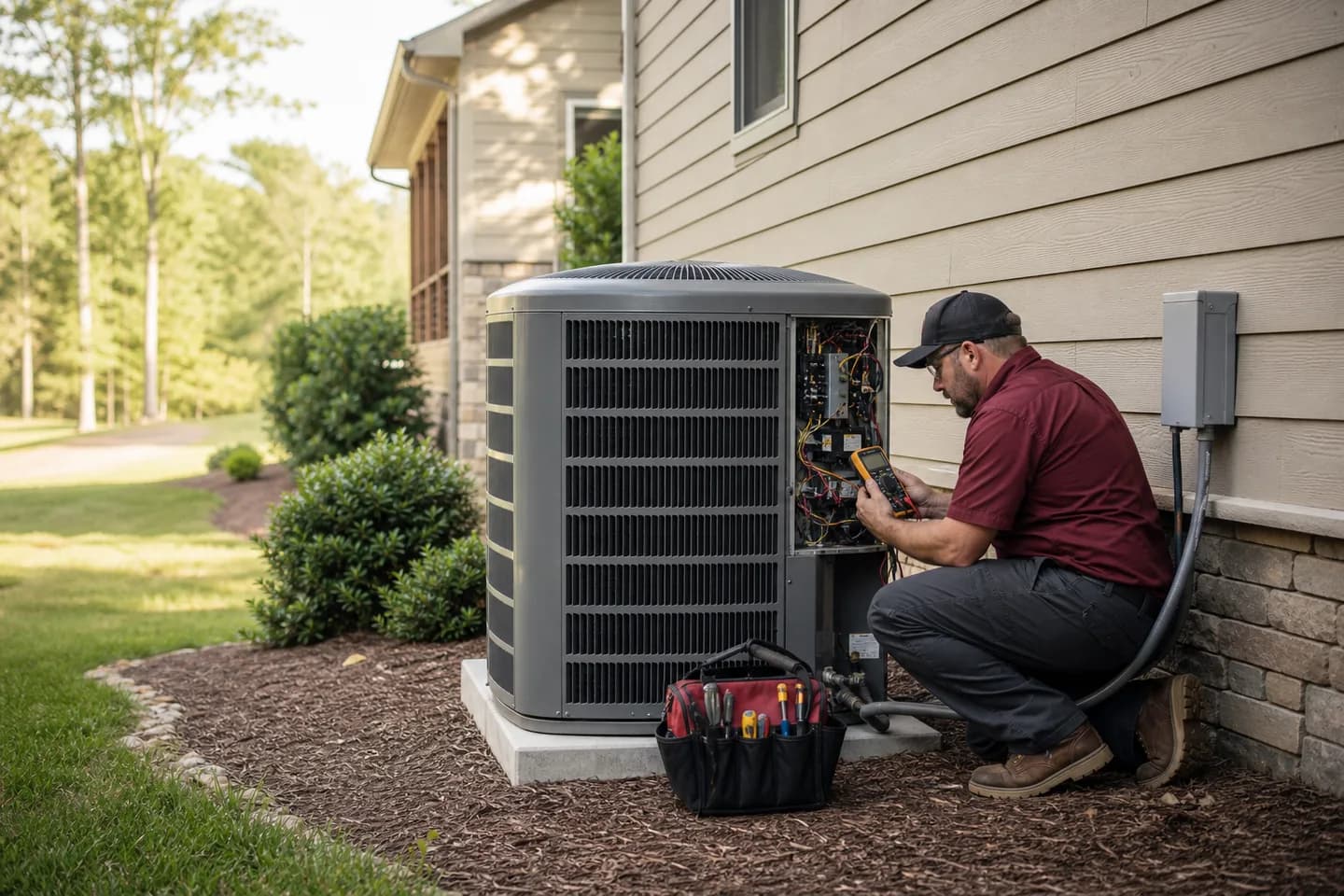
Contractor support for existing equipment
Repair service should connect technical testing with a clear scope of work.
Air Conditioning Repair Service in Jasper, GA gives homeowners a contractor who can diagnose a present failure and also understand how the repair fits the full system. Warm air, no airflow, short cycles, water, ice, noise, and breaker trips can come from different parts. A useful service visit identifies the cause before a repair is priced. It also separates the immediate breakdown from maintenance items or older installation concerns that did not cause today's problem.
Wayne Buras has spent 20 years in residential and light commercial heating and air. He studied at Chattahoochee Technical College and keeps current through manufacturer classes and seminars. As the owner and technician, he can explain the test results, repair option, parts needs, and larger system context without passing the customer between a salesperson and a service crew. Air Conditioning Repair Man was created to provide that direct, family-owned relationship.
From service request to confirmed symptom
The service request should describe what the homeowner sees rather than guessing at a part. State whether the thermostat works, the indoor fan runs, the outdoor unit runs, and the air feels cool. Mention when the problem began and whether it followed a storm, power interruption, filter change, or another repair. Water, ice, odors, breaker trips, and new sounds deserve specific detail because they change the diagnostic order and may call for shutdown instructions.
At the home, the technician confirms the symptom when it is safe and possible. An intermittent problem may not repeat, so stored codes, equipment history, photos, recordings, and operating readings become useful. The goal is to define what has changed from normal operation. This prevents the visit from beginning with a requested part that may not address the actual failure.
Testing the system in a logical order
An air conditioner needs thermostat demand, control voltage, line power, working indoor airflow, outdoor heat transfer, drainage, and a stable refrigerant circuit. The symptom determines which path comes first. A dead system starts with power, controls, fuses, transformers, safeties, and switches. Weak airflow starts with the filter, blower, coil, dampers, and ducts. Warm air with both units running adds temperature and refrigerant circuit tests.
Electrical measurements, temperature readings, pressure readings when appropriate, visual condition, and manufacturer fault information help narrow the cause. A code does not always identify a failed part. A low reading may be an effect of another condition. Wayne combines the numbers with equipment design and the homeowner's report before presenting a repair. This reduces part swapping and gives the written scope a clear technical basis.
- Confirm thermostat demand and the exact failed operating sequence
- Check power, controls, safeties, and electrical components tied to the symptom
- Review filter condition, blower operation, coil airflow, and drainage
- Test outdoor equipment and refrigerant performance when operating conditions allow
- Explain confirmed findings and limits before repair approval
Common repairs and the conditions around them
Capacitors, contactors, relays, transformers, fuses, motors, thermostats, boards, sensors, switches, pumps, and wiring can fail. A clogged drain may open a float switch and stop cooling. A dirty filter can reduce airflow and contribute to coil freezing. A weak condenser fan can raise outdoor operating stress. A refrigerant leak can lower capacity and needs evaluation beyond simply adding charge.
The failed part may not be the full story. A blown fuse can be caused by a short. A motor can fail after operating against high pressure. A safety switch may be protecting the home from water or equipment from abnormal temperature. The contractor should check the connected condition when possible. Repairing the reason behind the failure can reduce the chance of repeating the same call.
Written repair scope and customer approval
A repair option should identify the part or condition, work to be performed, expected result, price, and any important limit. If the first repair is needed before the rest of the system can be tested, that should be stated. For example, cooling performance cannot be fully checked when the blower will not run. The contractor can describe what is confirmed now and what will be evaluated after operation is restored.
Homeowners should have a chance to ask questions before added work begins. A maintenance suggestion, upgrade, or unrelated observation should not be mixed into the urgent repair as though it caused the failure. Wayne explains which work restores operation, which recommendation may improve reliability or comfort, and which item can be planned. That separation supports a decision without pressure.
Repairing older equipment responsibly
Older equipment is not automatically beyond repair. A focused electrical or control failure may still be practical. Larger repairs need a broader comparison. System age, major component condition, refrigerant type, parts availability, repair history, efficiency, comfort, and warranty all affect the decision. The contractor should first identify the present fault, then explain how the system is likely to stand after the repair.
Replacement becomes worth reviewing when repair cost is high, repeated failures are adding up, or the remaining system has major concerns. A replacement proposal should not be treated as the only answer before repair facts are available. Wayne presents both paths when they are reasonable. The homeowner can choose the short-term repair or longer-term equipment project based on the home and budget.
Building a useful service history
Keep invoices, diagnostic findings, part information, model numbers, warranty records, and maintenance dates together. Record the symptom that led to each call. A history can show whether a failure is isolated or part of a pattern involving drainage, airflow, controls, power, or age. It also helps a future technician know which parts have already been changed and what readings were observed.
Air Conditioning Repair Man can continue with maintenance, tune-ups, diagnostics, and replacement planning when needed. Wayne has lived in the Cherokee and Pickens County area for 39 years and started the company to build lasting customer relationships. Continuity is useful because the contractor learns the equipment and the customer has someone who can explain how today's repair connects with the system's longer life.
Common questions
AC contractor repair questions
Should I tell the contractor which part I think failed?
Share any observation or past repair, but describe the symptom first. Several parts can create the same result. Testing should confirm the cause before a replacement part is approved, even when an online search points toward a common failure.
Can the rest of the AC be tested before the first repair?
Sometimes only part of the system can be evaluated. A dead blower, control, motor, or compressor may prevent full performance testing. The contractor should state what is known, what remains untested, and what will be checked after operation is restored.
Why did a newly replaced part fail again?
The replacement may have been defective, but a connected electrical, airflow, wiring, control, or operating condition may also contribute. The contractor should test the circuit and surrounding system rather than replacing the same part again without review.
Will repair restore the original efficiency?
A repair can restore function affected by the failed part. Actual energy use also depends on equipment age, cleanliness, airflow, ducts, thermostat use, weather, home construction, and other conditions. The contractor should avoid promising a specific savings without supporting data.
Can maintenance be completed during a repair visit?
Some basic maintenance may be possible, but a full tune-up or cleaning scope may need added time and approval. The immediate repair comes first. Ask what was included, what remains, and whether a separate planned visit would provide better seasonal service.
Should I still schedule repair if the AC starts working after a reset?
A reset may restore operation without correcting the cause. If a breaker, safety, or control stopped the system, note what happened and arrange diagnosis, especially if the condition repeats. Do not repeatedly reset a breaker or operate equipment with odor, severe noise, water, ice, or visible damage.
What should a written AC repair summary include?
It should identify the equipment and symptom, the confirmed condition, work completed, parts installed, operating checks, and any remaining limit or recommendation. Clear records help with warranties and give a future technician useful history if a related symptom appears again.