A documented look at furnace condition and operation
A useful furnace inspection has a defined scope and honest limits.
Furnace Inspection in Jasper, GA gives a homeowner a structured review of accessible equipment, present condition, controls, airflow, and operating behavior included in the visit. An inspection may support seasonal planning, a recent home purchase, a concern about older equipment, or a second look after a change in sound or performance. It is different from repairing a known failure, and the written scope should show whether cleaning, maintenance, or specialized testing is included.
Wayne Buras owns and operates Air Conditioning Repair Man. He has 20 years of residential and light commercial HVAC experience, trade-school education from Chattahoochee Technical College, a Georgia warm-air license held since 2007, and EPA Section 608 Universal Technician certification. Wayne continues manufacturer education and explains findings in plain language. The goal is to give the customer a useful condition report rather than a vague pass or fail statement.
Setting the purpose and inspection scope
Tell the contractor why you are requesting the inspection. A furnace that is not operating needs diagnostic service. A system that runs but has gone without care may need maintenance. A buyer or owner looking for current condition may want documentation of visible equipment, thermostat response, operating sequence, filter and airflow observations, electrical condition, ignition, safeties, venting, and performance within safe access.
Ask what the standard inspection includes and excludes. Heat-exchanger access, camera work, combustion analysis, gas-pressure measurements, deep cleaning, duct testing, repair, and disassembly may not be part of every visit. Weather, fuel availability, locked spaces, finished construction, stored belongings, or an existing failure may limit operation. Those limits belong in the final report so no one assumes an inaccessible component was inspected directly.
Identifying the furnace and connected system
The inspection begins with equipment type, model and serial information, installation arrangement, fuel or electrical source, thermostat, filter location, return and supply connections, venting when present, and any connected cooling or heat pump equipment. A furnace may serve as the blower and control center for central air conditioning. In a dual-fuel system, it may operate only under certain temperatures or control decisions.
Visible age and surface condition provide context, but they do not prove safe or failed operation. Past installation, maintenance, repairs, water exposure, renovation dust, pest activity, and changes to ducts or controls can affect the present system. Service records, warranty documents, and homeowner observations help the technician understand what has changed. Model information also supports the correct operating sequence and manufacturer guidance.
- Equipment identity, location, access, and general cabinet condition
- Thermostat demand, control response, and visible wiring concerns
- Filter, blower, return, supply, and accessible airflow conditions
- Ignition, heating stages, safeties, venting, and drainage as applicable
- Written findings, limits, repair needs, and planning observations
Cabinet, electrical, blower, and airflow observations
Accessible cabinets and connections can show corrosion, water staining, overheating, damaged insulation, loose panels, debris, poor support, or signs of past work. Electrical inspection may review disconnects, visible wiring, grounding, connections, controls, motors, relays, and current or voltage measurements when they are part of the scope. Power must be handled by trained personnel because furnace cabinets contain both control voltage and dangerous line voltage.
The filter should fit its rack and allow the airflow the system needs. A restrictive filter, dirty blower, impacted coil, blocked return, closed vents, damaged duct, or incorrect blower setting can affect comfort and furnace temperature. Basic observations may show a concern. Pressure and airflow testing can provide more evidence when the scope includes it. The report should distinguish a directly measured restriction from a general recommendation to investigate further.
Fuel-burning operation, venting, and safeties
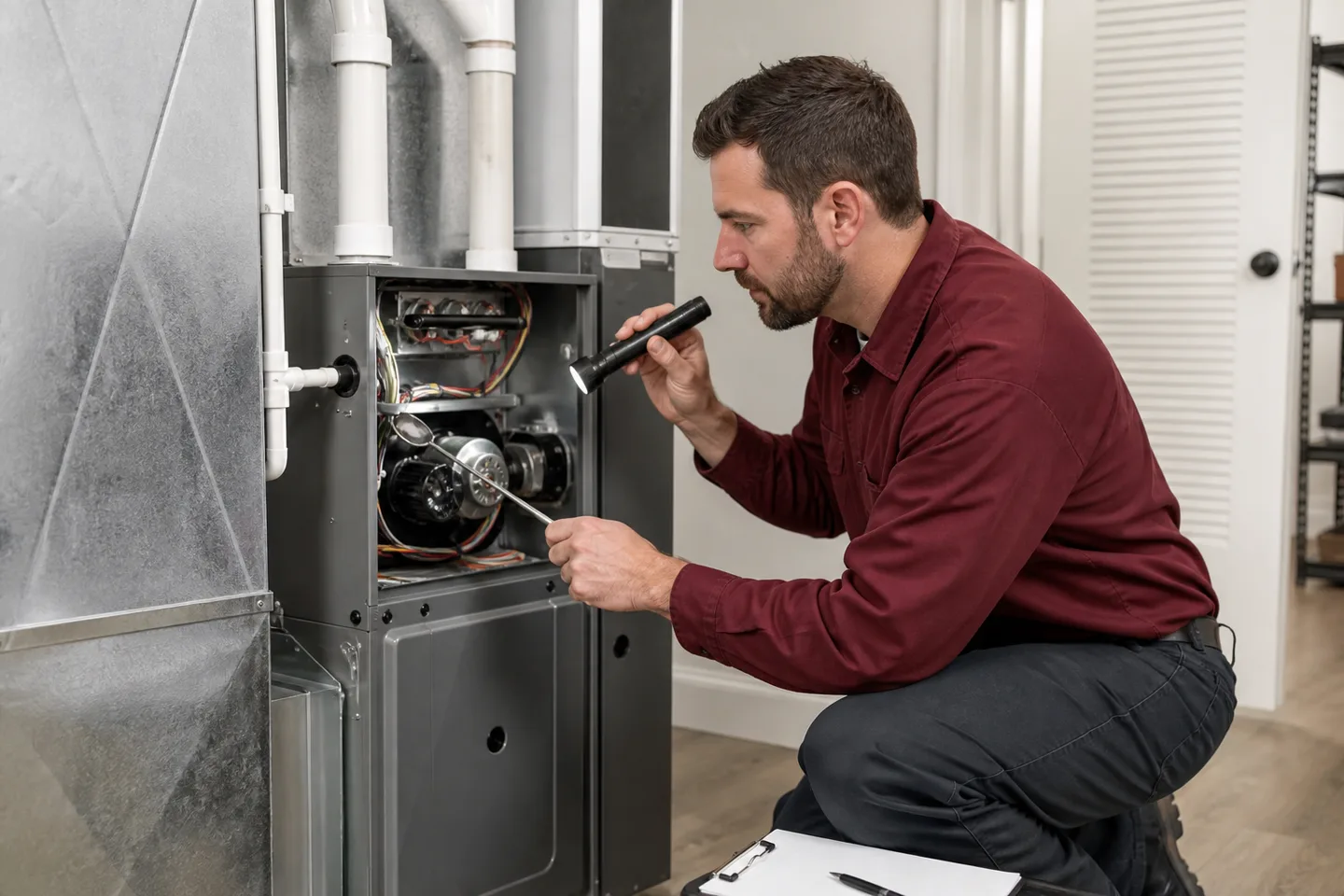
For fuel-burning equipment, the inspector may review the call for heat, inducer, ignition, burners, flame proving, blower timing, temperature behavior, accessible venting, combustion-air conditions, drainage on condensing furnaces, and safety response within the agreed service. The exact procedure follows furnace design and manufacturer information. Combustion or gas measurements require appropriate instruments and may be a stated addition rather than part of a basic visual inspection.
A furnace safety that opens should not be reset and ignored. It may be responding to overheating, flame loss, venting, pressure, drainage, or another condition. Visible vent damage, signs of overheating, rollout, combustion concerns, or a suspected heat-exchanger problem may require shutdown and further evaluation. Carbon monoxide alarms support household safety but do not replace equipment inspection, and a normal inspection cannot promise that no future failure will occur.
Electric heat and heat pump connections
Electric furnaces and air handlers may use multiple heating elements, sequencers or relays, limits, breakers, and blower controls. The inspector can review staging and electrical operation within the selected scope. High current and heat make damaged connections or failed stages meaningful. A system can still produce some warm air while one stage is not working, so thermostat response and output should be viewed together.
When a heat pump is connected, indoor electric heat may serve as auxiliary or emergency heat. Outdoor temperature, thermostat configuration, defrost, sensor inputs, and controls affect when it operates. A furnace inspection does not automatically include full heat pump diagnosis. The report should identify which indoor heating functions were checked and whether outdoor or cooling-related testing needs a separate HVAC diagnostic or seasonal visit.
Reading the report and deciding what comes next
A clear report identifies the equipment, inspected areas, operating conditions, observations, measurements when taken, photographs when useful, and access limits. Findings should be separated into current repair or safety needs, maintenance items, optional improvements, and future planning. Age alone belongs in the planning context. It should not turn every operating furnace into an automatic replacement recommendation.
If a repair is recommended, ask what evidence supports it, what work is proposed, and which operation will be checked afterward. If cleaning or maintenance remains, ask for its scope separately. Save the report with later invoices so changes can be tracked. Air Conditioning Repair Man uses inspection as a way to replace uncertainty with specific information and give the homeowner a reasonable path forward.
Common questions
Furnace inspection questions
Is a furnace inspection the same as maintenance?
Not always. Inspection documents accessible condition and operation within a stated scope. Maintenance adds recurring care, cleaning, or adjustments. The services may overlap, so ask for the exact task list before scheduling.
Can a furnace be inspected if it will not start?
Some visual checks are possible, but a nonworking furnace usually needs diagnostic service. The failure may prevent inspection of later operating stages. The report should state what could not be tested until repair restores operation.
Does every furnace inspection include a heat-exchanger inspection?
Scope and access vary. Ask how accessible surfaces are reviewed, whether added tools or disassembly are included, and what limitations apply. No method makes every surface visible in every installed furnace.
Will an inspection tell me how many years the furnace has left?
It can document current condition, age, operation, and observed wear, but it cannot predict an exact remaining life. Service history, use, installation, environment, maintenance, and unexpected component failures all affect future operation.
Should I receive a written furnace inspection report?
A written report is useful for planning and future comparison. It should identify what was checked, findings, limits, and next steps. Ask before the appointment if you need a particular format for a property or warranty purpose.
How should I prepare for a furnace inspection?
Clear the equipment, thermostat, electrical panel, and vent or utility areas that need access. Secure pets, provide service records, and describe any recent code, odor, noise, shutdown, filter problem, or comfort change.
Can a furnace inspection guarantee that the equipment is safe for the entire season?
No inspection can predict every later failure or hidden change. It documents accessible condition and operation at the time of service within its scope. Household alarms, proper use, ongoing observation, maintenance, and prompt attention to new odors, codes, sounds, shutdowns, or vent damage remain part of heating safety after the visit.