Measured repairs for dependable home heating
A furnace repair should explain why the heating sequence stopped.
Furnace Repair in Jasper, GA starts with the symptom inside the home and the operating sequence inside the equipment. A furnace may fail to start, ignite and shut down, blow air without enough heat, run with weak airflow, cycle too often, make a new noise, or display a control code. Each symptom can have several causes. The technician needs to identify the furnace, reproduce the problem when safe, and test the step where normal operation changes.
Air Conditioning Repair Man is owned by Wayne Buras, an HVAC technician with 20 years of residential and light commercial experience. Wayne studied at Chattahoochee Technical College, has held a Georgia warm-air license since 2007, and is an EPA Section 608 Universal Technician. He also attends manufacturer training as controls and equipment change. Homeowners work directly with someone who can explain the diagnosis, repair scope, and result before and after the work.
Knowing when the furnace needs repair
A complete loss of heat is the clearest sign, but smaller changes can provide earlier warning. Watch for repeated starts, longer run times, a blower that never stops, rooms falling behind, new rattling or squealing, ignition attempts, thermostat power loss, and recurring fault messages. A brief dusty odor at the first seasonal start differs from an ongoing electrical, melting, fuel, or exhaust odor. Tell the contractor exactly when the change occurs.
Check the thermostat mode and setting, confirm that accessible vents are open, and inspect the filter without opening equipment panels. A homeowner may reset a tripped breaker once when there is no smoke, odor, water, or visible damage. If it trips again, leave it off. Do not remove combustion panels, light burners by hand, push switches, bypass safeties, or repeatedly cycle a furnace that is failing to ignite.
- No heat or air that never becomes warm enough
- Ignition attempts followed by an early shutdown
- Repeated starts, short cycles, or a blower that runs constantly
- New mechanical, electrical, burner, or airflow sounds
- A recurring code, breaker trip, odor, or visible equipment damage
Following a gas furnace sequence
A typical gas furnace receives a thermostat demand, checks controls and safeties, starts an inducer, proves the pressure condition, begins ignition, opens the gas valve, proves flame, and starts the circulating blower after a delay. The exact order and components vary by model. If flame is not proven or a safety opens, the control may stop fuel and store a code. That protective response is a clue, not a reason to bypass the control.
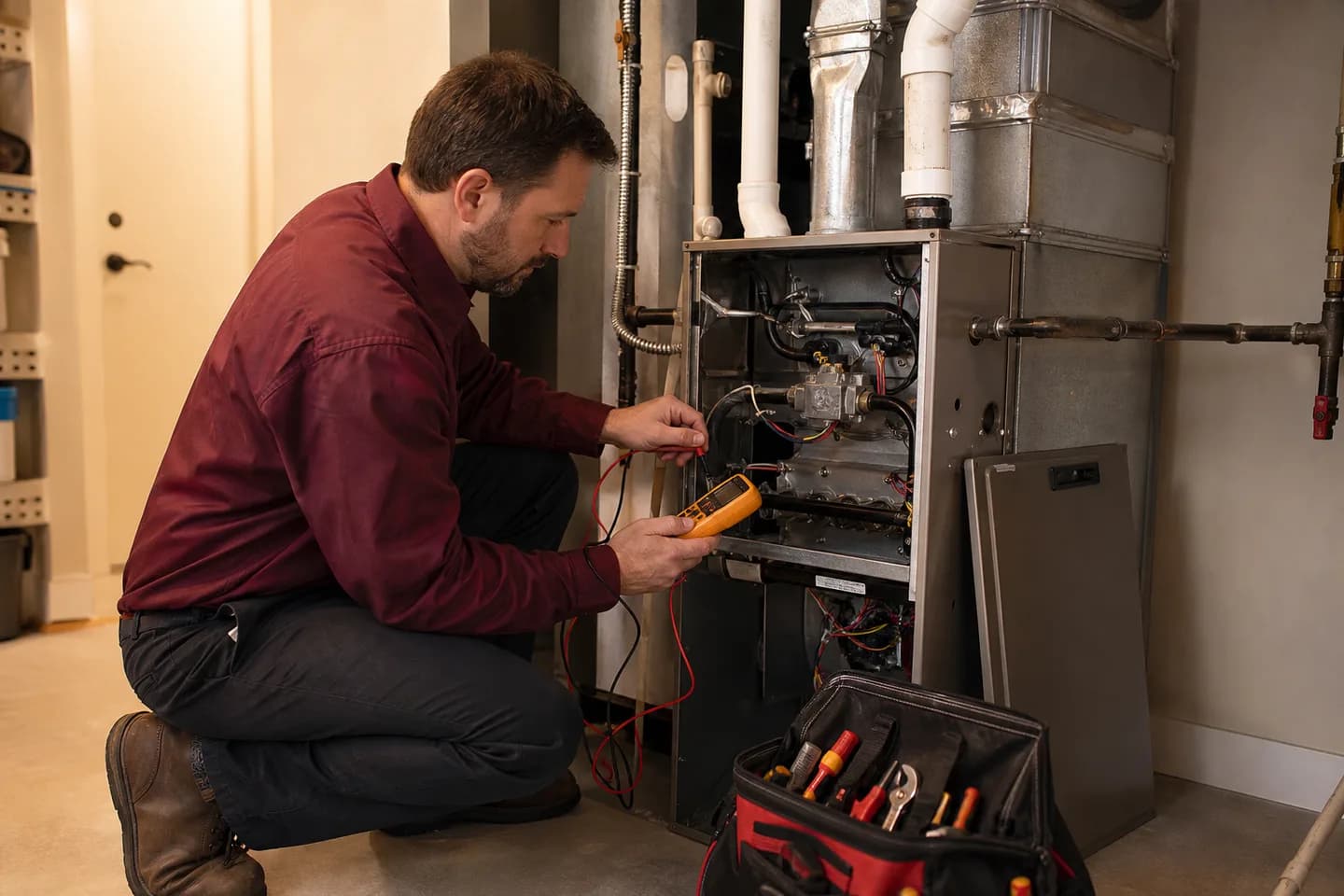
The technician tests the stage where the sequence stops and the conditions that feed it. A pressure-related code can involve venting, drainage on condensing equipment, tubing, inducer performance, switches, or another restriction. A limit code can involve airflow, blower operation, a dirty component, setup, or overheating. An ignition problem can involve the igniter, flame sensing, fuel delivery, grounding, wiring, or controls. Measurements separate these paths.
Electric furnaces, heat pumps, and shared components
An electric furnace uses staged heating elements, relays or sequencers, limits, a blower, and controls rather than burners and a flue. A heat pump system may use electric heat as backup during colder weather, defrost, or a large thermostat change. A problem that looks like furnace failure may actually begin with the heat pump, thermostat configuration, outdoor sensor, control wiring, or the way auxiliary heat is being called.
Heating and cooling often share the thermostat, blower, filter, ducts, electrical supply, and control board. Weak airflow can reduce heating output and cause a furnace to open a temperature safety. A blower fault can affect both seasons. The repair should account for the complete installed system, not just the component used to create heat. Model information and wiring diagrams help confirm how the equipment is designed to work together.
Safety during furnace diagnosis and repair
Smoke, sparking, burning electrical odor, severe noise, or a repeated breaker trip calls for shutdown. If anyone suspects natural gas or carbon monoxide, leave the building and contact emergency services or the gas utility from a safe location. Do not operate lights or switches while leaving a suspected gas leak. A heating company handles equipment repair after the property is safe for entry and the proper emergency response has occurred.
Fuel-burning furnace work may involve ignition, gas pressure, flame characteristics, venting, combustion air, temperature rise, limits, and heat-exchanger condition as the diagnosis requires. Electric furnace work may involve high voltage and high current. Protective switches should remain in the circuit. If a condition cannot be made safe during the visit, the contractor should explain why the equipment must remain off and what work is needed before normal operation resumes.
Approving the repair and verifying operation
Once testing supports a diagnosis, the homeowner should receive the proposed work and price before repair begins. Ask whether the part is equipment-specific, whether a return visit is needed, and which related checks are included after installation. A temporary measure should be used only when it is safe and compatible. A contractor should not bypass a limit, pressure switch, flame control, or other safety to provide temporary heat.
Post-repair testing should repeat the affected operating sequence and check the connected function. That may include thermostat response, ignition, flame proving, electrical operation, blower timing, temperature change, airflow, safeties, heat pump functions, or multiple heating stages. If weather, access, or another failure prevents a complete test, the final report should state the limit. The customer should know whether normal operation is allowed and what sign calls for another shutdown.
When repair and replacement both deserve review
Many older furnaces can be repaired when the failure is clear, parts are available, and the rest of the equipment supports the work. Age alone does not diagnose a furnace. Replacement becomes a practical comparison when a major repair combines with repeated failures, serious deterioration, difficult parts, persistent comfort problems, or a safety-related condition that cannot be corrected reasonably.
Compare the confirmed repair with a full replacement scope. Equipment selection, heat load, fuel or electrical needs, ducts, venting, drainage, controls, and the connected cooling system can affect the project. Wayne explains what the repair changes and what it leaves in place. Keep that explanation, the invoice, parts information, and operating notes so the next service decision begins with a useful history instead of the furnace age alone.
Common questions
Furnace repair questions
Why does my furnace start and then shut off?
The control may be responding to ignition, flame proving, venting, temperature, airflow, drainage, or another safety condition. The timing and stored code can help, but the connected components still need testing before a repair is selected.
Can I reset my furnace myself?
You may check the thermostat and reset a tripped breaker once when no unsafe sign is present. If the problem returns, leave the equipment off and arrange service. Do not keep resetting controls or bypass any furnace safety.
Why is the furnace running but the house is still cool?
Possible causes include thermostat settings, weak airflow, a dirty filter, duct leakage, staging problems, failed heating components, heat pump issues, or a building load beyond current output. The room pattern and system measurements help narrow the cause.
Can a furnace repair be finished during the first visit?
Many repairs can be, but equipment-specific parts, access, safety conditions, and additional testing may require return work. The contractor should document the diagnosis, whether operation is allowed, and the next step when the repair cannot be completed immediately.
Does a furnace fault code identify the bad part?
A code usually identifies the condition the control detected, not a guaranteed failed part. Airflow, wiring, controls, switches, venting, fuel, drainage, and connected components can create the same code. Diagnosis tests those possible causes.
What should I do after a furnace repair?
Review what was repaired and tested, follow filter and operating guidance, keep the written record, and watch for the original symptom. Ask which warranty applies and whether maintenance or another follow-up check is recommended separately.